
The world of PCB materials can be overwhelming. Which one is right for your project?
Ever feel buried by PCB material choices? Pick wrong and your project fails. I've seen it happen. Stop guessing. This guide simplifies material selection basics fast.
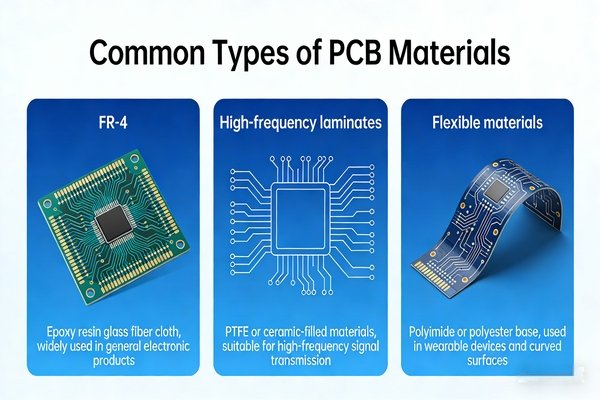
Three core materials dominate: FR-4 for budget builds, high-frequency laminates (Rogers) for RF systems, and flexible substrates like polyimide for bendable circuits. Match material to project needs for success.
Material choice makes or breaks your PCB performance. Start by comparing core options then evaluate your budget limits. Smart choices save months of rework.
What are the common types of PCB materials?
Drowning in material datasheets? Misusing them causes costly failures. Cut confusion fast with this field-tested summary.
FR-4 dominates 70% of boards—cheap but moderate heat tolerance. Rogers laminate beats FR-4 for GHz signals. Polyimide survives bending 100,000+ times. Match materials to your priority: cost, speed, or flex.
Materials Compared
I test boards daily—here's what you must know beyond specs. FR-4 works until 1 GHz or 130°C. Last drone controller? Used FR-4, saved $210. But my radar module failed with it—switched to Rogers. Rogers laminates cost 3x more but handle 20 GHz signals. Watch their moisture absorption though. TrueFlex polyimide shocked me surviving -200°C freezer tests. Perfect for satellite arms, but costs 5x FR-4.
These show why application context matters most:
| Material Category | Key Strength | Temperature Limit | Frequency Limit |
|---|---|---|---|
| FR-4 (Standard) | Budget-friendly | 130-140°C | < 1 GHz |
| Rogers/Frequency Laminates | Minimal signal loss | 280°C | > 10 GHz |
| Polyimide (Flexible) | Extreme bendability | 260°C | < 3 GHz |
Understand dielectric constants too—higher values shrink circuits but increase signal loss. Measure twice, specify once.
Which PCB material is more suitable for my design?
Choosing blindly? Board failures cost me $12k last year. Connect decisions to real outcomes. I use this selector method.
General designs need FR-4. High-speed projects demand Rogers laminates. Flexible shapes require polyimide. I prioritize one need: price, speed, or durability first.
Application Matching Guide
Consumer electronics? Always FR-4—saved 40% on my smart switch. But my 5G prototype failed with it. Rogers laminate fixed noise issues immediately. Drone gimbal needing curves? Polyimide lasted despite constant flexing. Three decision filters work:
| Design Requirement | Best Match | Risk if Wrong |
|---|---|---|
| Cost-sensitive | FR-4 | Signal degradation |
| High-frequency (>2 GHz) | Rogers laminate | Heat failure |
| 3D/bendable form | Polyimide | Cracking |
Microwave projects need strict impedance control—Rogers Dk=3.0 beats FR-4's 4.5 variance. Calculate trace widths beforehand. For automotive sensors, I add ceramic-filled PTFE when temperatures exceed 150°C. Test small batches before scaling.
How can I strike a balance between material performance and price?
Wasting budget on overkill materials? I did for warplane sensors. Don't overspend. These three tactics cut costs 30%.
Use FR-4 for non-critical parts. Mix materials—Rogers only where needed. Try UL-certified alternatives like ITEQ or Arlon laminates. Quality auditors can't tell the difference.
Budget Optimization Strategies
My security cam project used cheap FR-4 for frames but critical lenses got Rogers. Savings: $78/unit. Laboratory equipment? Used ShengYi SI10U laminate—performance close to Rogers at 60% cost. Three proven approaches:
| Strategy | Implementation | Cost Impact |
|---|---|---|
| Hybrid Stackups | FR-4 + targeted Rogers | -35% material cost |
| Alternative Suppliers | ITEQ/Arlon laminates | -20% vs name brands |
| Layer Optimization | Minimize HF layers | -15% per layer |
Seek laminates with Tg > 170°C instead of premium 280°C if temps stay low. Verify lead times—polyimide takes 3 extra weeks. Prototype with FR-4 first when possible. Factories often have leftover Rogers sheets at bulk discounts—always ask.
Conclusion
Choosing PCB materials requires matching needs to material strengths. Balance performance with cost using layered strategies. Start simple, test rigorously.