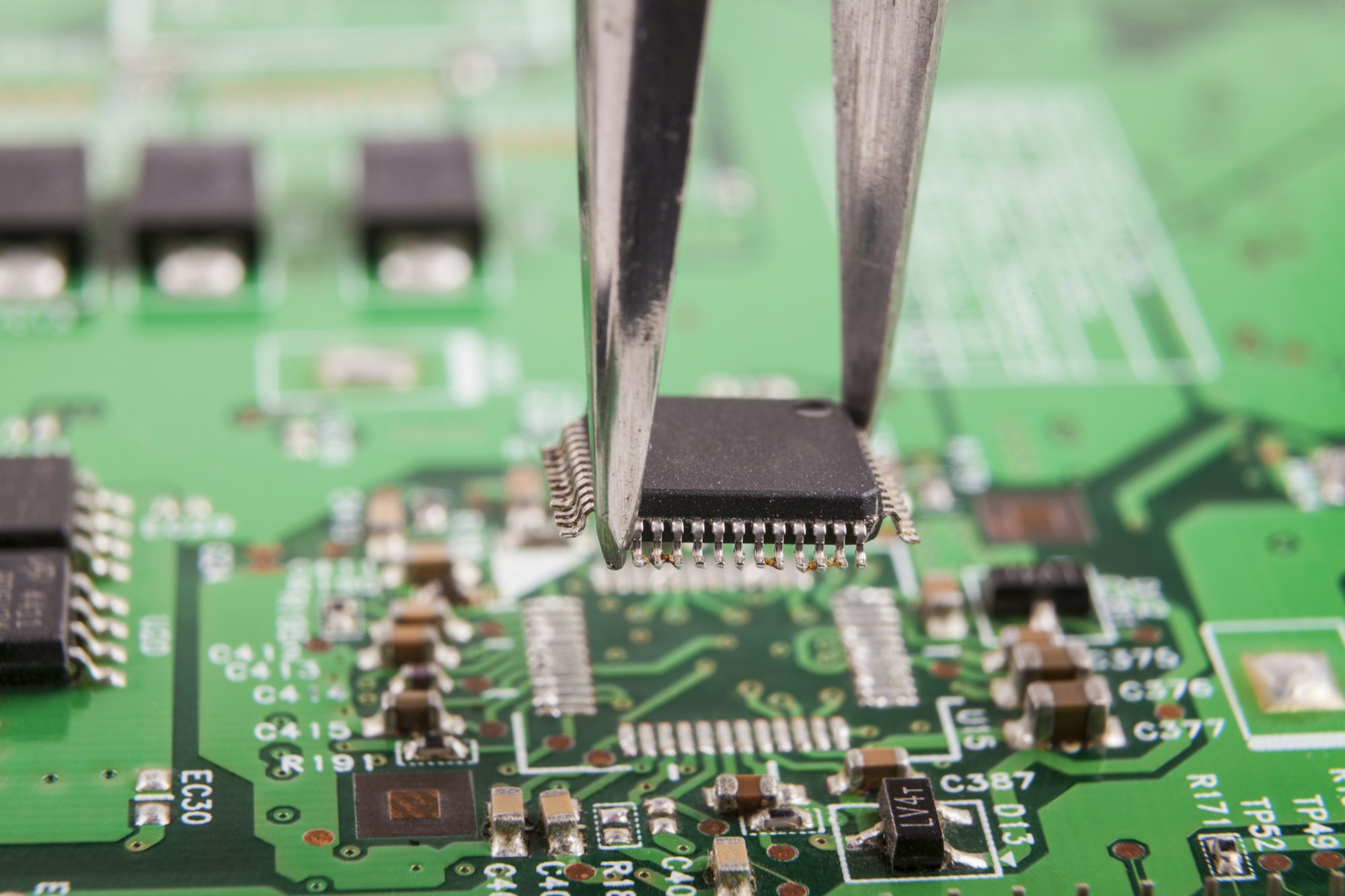
Do you ever wonder how all those tiny parts get on a circuit board? It can be confusing trying to figure out how everything connects.
Yes, almost all printed circuit board (PCB) assembly processes require soldering. Soldering creates strong electrical and mechanical connections between components and the board. This ensures your electronic devices work reliably.
Let's dive into the world of PCB assembly. We'll explore why soldering is so vital and look at the different ways components are attached. You'll see how this crucial step brings electronic circuits to life.
What are the steps for through-hole technology PCB assembly?
Are you curious about how older components are placed on circuit boards? It might seem like a lot of steps to get those parts connected.
Through-hole technology (THT) PCB assembly involves inserting component leads through holes in the PCB and then soldering them on the opposite side. This method creates very strong physical connections, often used for larger or heavier components.
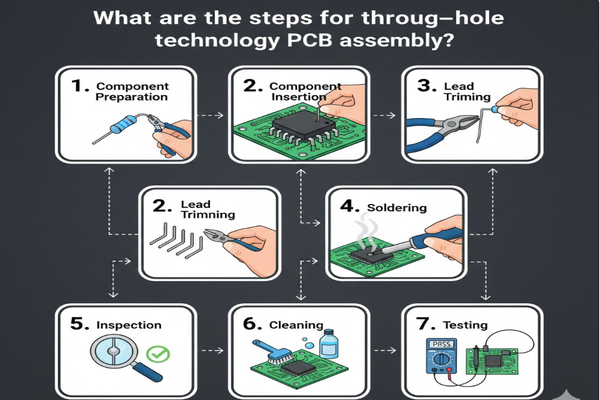
Through-hole technology is a foundational method in electronics manufacturing, despite the rise of surface mount technology. My first electronics project involved a simple THT board. I remember carefully inserting each resistor and capacitor, then flipping the board to solder them in place. This hands-on experience showed me the importance of each step. The process begins with preparing the components, ensuring their leads are clean and properly formed. Next, these components are manually or automatically inserted into the designated holes on the PCB. The board then moves to the soldering stage, typically wave soldering[^1], where the underside of the board passes over a wave of molten solder, or hand soldering[^2] for intricate parts. After soldering, the board undergoes inspection to check for solder bridges[^3], cold joints[^4], or other defects. Finally, excess leads are trimmed, and the board is cleaned before final testing.
Component Preparation
- Lead Forming: Leads are bent to fit hole spacing.
- Cleaning: Leads are cleaned to ensure good solderability.
Component Insertion
- Manual: Operators place components by hand.
- Automated: Machines place components at high speeds.
| Step | Description | Key Tool |
|---|---|---|
| Soldering | Forming electrical and mechanical connections. | Wave Soldering |
| Inspection | Checking for defects like shorts or open circuits. | AOI, X-ray |
| Lead Trimming | Cutting off excess component leads. | Manual/Automatic |
| Cleaning | Removing flux residues. | Ultrasonic Bath |
What are PCB assembly and soldering techniques?
Ever wondered about the different ways parts are attached to a circuit board? It can feel overwhelming with all the technical terms.
PCB assembly combines various techniques to mount components onto a board, with soldering being the primary method for electrical connection. Techniques range from surface mount technology (SMT)[^5] for tiny parts to through-hole technology (THT)[^6] for larger ones.
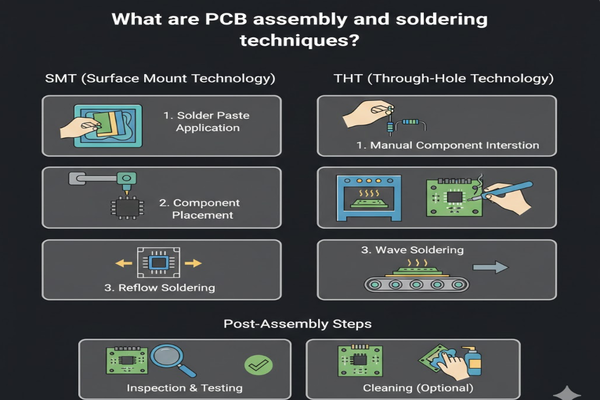
When I first started learning about electronics, I thought all components were attached the same way. It wasn't until I visited a manufacturing plant that I realized the incredible variety of techniques. PCB assembly is a multifaceted process that involves more than just placing components. It encompasses a range of methods tailored to different component types and board designs. The two main categories are through-hole technology (THT) and surface mount technology (SMT). THT, as we discussed, involves inserting leads through holes. SMT, however, involves placing components directly onto the surface of the PCB. This allows for much smaller and denser boards. Within SMT, reflow soldering is common, where solder paste is applied, components are placed, and the board is heated to melt the solder. Wave soldering is typically used for THT and sometimes for mixed technology boards. Hand soldering is reserved for prototyping, rework, or very specific components. Each technique has its own advantages and challenges in terms of speed, cost, and reliability.
Surface Mount Technology (SMT)
- Solder Paste Application: Stenciling solder paste onto pads.
- Component Placement: Pick-and-place machines position components.
- Reflow Soldering: Heating the board to melt solder paste.
Through-Hole Technology (THT)
- Component Insertion: Placing components through holes.
- Wave Soldering: Passing the board over a wave of molten solder.
- Hand Soldering: Manual soldering for specific components or repairs.
| Technique | Component Type | Advantage | Disadvantage |
|---|---|---|---|
| Reflow Soldering | SMT Components | High density, automated | Can be sensitive to heat |
| Wave Soldering | THT Components, some SMT | Strong mechanical connection | Less dense than SMT |
| Hand Soldering | Prototypes, Rework | Flexibility, precision for few | Slow, labor-intensive |
What is PCB assembly and soldering?
Are you trying to understand what makes an electronic circuit board work? It can be confusing to grasp the core process.
PCB assembly is the process of attaching electronic components to a bare printed circuit board, and soldering is the key method used to create reliable electrical connections. It's how a blank board becomes a functional electronic device.
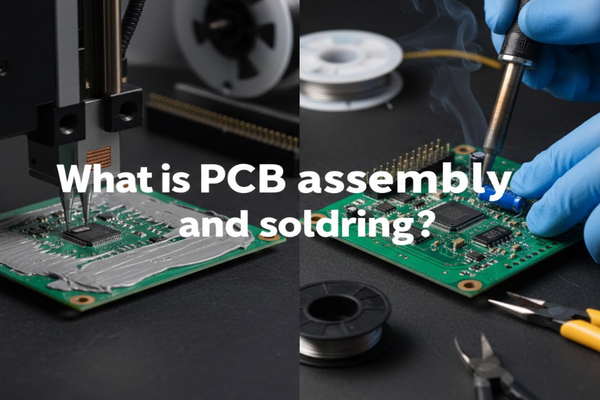
Understanding PCB assembly and soldering is fundamental to comprehending how modern electronics are built. From the smallest smart device to the largest industrial control system, the principles remain the same. PCB assembly transforms a bare board, which is essentially just a network of conductive pathways, into a fully functional electronic module. This transformation relies heavily on soldering. Soldering involves using a molten metal alloy, called solder, to form a metallurgical bond between the component leads (or pads) and the copper traces on the PCB. This bond provides both the necessary electrical pathway for signals and power, and the mechanical stability to hold the component in place. Without proper soldering, components would not function correctly, leading to intermittent failures or complete system breakdowns. I remember working on a faulty guitar pedal; the issue was a "cold" solder joint – a connection that looked good but wasn't electrically sound. Re-soldering it fixed the problem instantly, showing me how critical good soldering truly is.
The Role of Solder
- Electrical Connection: Forms a conductive path.
- Mechanical Connection: Secures components physically.
Types of Solder
- Lead-Free Solder: Environmentally friendly (e.g., Tin-Silver-Copper).
- Leaded Solder: Traditional (e.g., Tin-Lead), used in some applications.
| Aspect | Description | Importance |
|---|---|---|
| PCB Fabrication | Creating the bare board with traces and pads. | Foundation for assembly |
| Component Sourcing | Acquiring all necessary electronic parts. | Ensures correct functionality |
| Assembly Process | Mounting components (THT, SMT). | Physical placement |
| Soldering | Joining components to the board. | Electrical and mechanical bond |
| Testing | Verifying functionality and quality. | Ensures product reliability |
Conclusion
Almost all PCB assembly requires soldering to create robust electrical and mechanical connections. This crucial step transforms a bare board into a functional electronic circuit.
[^1]: Learn about wave soldering and its effectiveness for through-hole components. [^2]: Discover the applications of hand soldering for precision and repairs in PCB assembly. [^3]: Understand solder bridges and their impact on circuit functionality. [^4]: Learn about cold joints and how they can affect electronic device performance. [^5]: Understand SMT and how it revolutionizes the assembly of compact electronic devices. [^6]: Discover the traditional method of THT and its significance in electronics manufacturing.